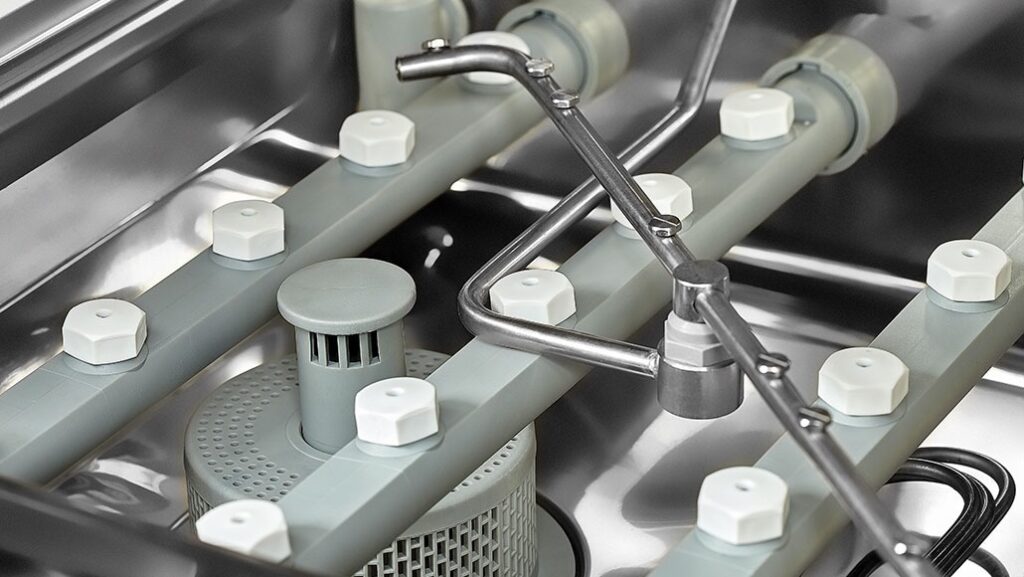




The most important thing when washing well inside the chamber of a professional dishwasher or tunnel dishwasher is to be able to reach every corner of the dishes, evenly and with the right pressure. The washing system used by the machine is critical when it comes to removing all the dirt. Therefore, whenever we have to decide on a dishwasher, we must ensure that the distribution of water inside the chamber is perfect and that both the pressure and the flow rate are powerful enough to remove the remains of encrusted dirt.
In the rinsing process of a professional dishwasher, these parameters are not so critical since, once the dirt has been washed and removed, we only have to rinse the detergent that has been applied in the washing process and disinfect with temperature (85ºC).
There are two systems on the market, the fixed arm system, which is the most powerful and homogeneous, and the rotating arm system. Both generally obtain good results, but one has better performance than the other, let's see why...
SWIVEL ARM SYSTEM
NOT HOMOGENEOUS OR CONSTANT: The rotating arm system does not have the same homogeneous and constant water distribution as the fixed system. As it is a mobile system, both the water flow and the water pressure at the same point of the dishes is discontinuous, with variable water pressures and flows.
AREAS WITH LITTLE WASHING ACTION: The area of application is also not the same, as the chamber of a professional dishwasher is square. The baskets of both dishwashers and tunnel dishwashers are also square. However, the rotating arms cover a circular area due to their rotational nature on a central axis, leaving the corners of the chamber with a different water flow and pressure than in other areas such as the centre.
UNCOMPENSED PRESSURE: The rotating arm systems of professional dishwashers present another added problem, and that is that as they do not have a fixed application point, they require different washing powers depending on the type of dishes. For example, for small coffee dishes we should have the possibility to regulate the pressure, otherwise the dishes could move or jump inside the dishwasher or washing tunnel, causing damage or even breakage. In the fixed arm system, the upper and lower pressures are compensated, so that the items to be washed are held in position without moving.
THEY REQUIRE MORE WASHING TIME: Another characteristic of the rotating arm system is that they need more time to wash than the fixed arm system. This is due to the fact that the flow and pressure that a point to be washed receives is discontinuous and lower than the fixed arm system, being constant and higher.
FIXED ARM SYSTEM
HOMOGENEOUS AND CONSTANT: This system presents a perfect homogeneity both of water distribution inside the square chamber and of pressure and flow rate, which are constant at all points.
COMPENSATED PRESSURE: As we can see in the illustration, this is a static system, which uses more water flow and pressure. As this pressure is compensated by the upper arms, it is not necessary to have pressure regulators. We can always wash in the same way without stopping or having to reprogram the machine depending on the dishes in the professional dishwasher or tunnel washer. Thanks to the Pull Up system, the arms are easy to remove without tools for quick cleaning.
FASTER WASHING: By having a higher pressure and flow rate combined with a constant pressure throughout the washing time, we obtain better results in less time.
In this video we can see how a balloon behaves inside a chamber with both systems, the homogeneities in all senses make the difference between control and chaos.
The question is:
Why are rotating arms installed instead of fixed arms if we can clearly see that one is better than the other?
Response:
The cost and robustness of a fixed arm system is much higher than that of rotating arms, but at Jemi, being robustness our DNA, we only use fixed arms, being an investment for the benefit of our clients, and considering it the best and most beneficial option.
Because our dishwashers are Simply built to last